
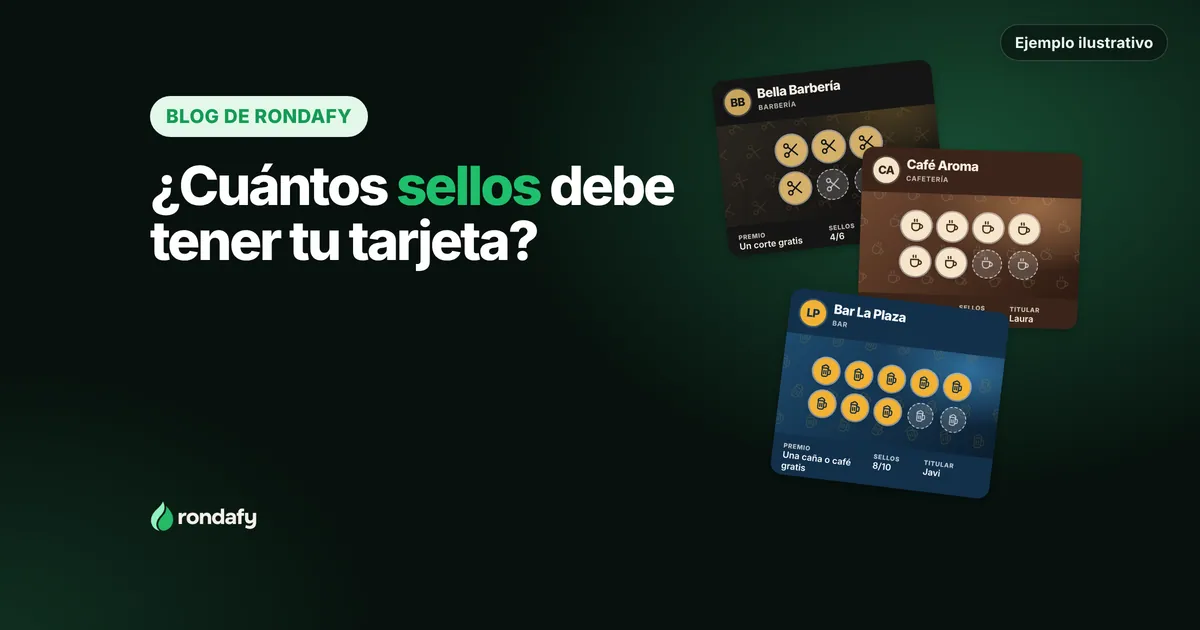
Short answer: the usual range is 6 to 10 stamps. If your customer comes almost every day, 8 to 12; if they come every three to five weeks, as in a barbershop, 5 or 6. The ideal number is the one that lets a regular fill the card within a few weeks (or a few months if the service is infrequent) without the reward costing you more than is reasonable.
The rule of thumb
Choose a number of stamps that a regular customer can complete within a reasonable time for your type of business:
- Daily or near-daily purchase (cafés, bakeries, bars): the reward should come within 2 to 4 weeks. Between 8 and 12 stamps usually works.
- Weekly visit (set-menu restaurants, classes): between 6 and 10 stamps.
- Visit every few weeks (barbershops, hair salons, nails): between 5 and 8 stamps, so the reward comes within a few months.
How to work it out with your numbers
- Estimate how many days your regular customer takes to come back.
- Decide how long you want them to take to complete the card.
- Divide: target time ÷ days between visits = number of stamps.
- Check the cost: reward cost ÷ (stamps × average spend per visit). That percentage is what you «give back» to the customer.
Rough example for a café: if your regular customer comes every 2 days and you want them to complete the card in about 3 weeks, you get about 10 stamps. If each visit brings in €2 and the free coffee costs you €0.30, you give back 1.5% of what they've spent. These are example figures: do the maths with yours.
Stamps = target time frame in days ÷ days between visits. Example: a 30-day time frame and one visit every 4 days → about 8 stamps. Then check that the reward doesn't cost you more than you're willing to invest.
Run a café? See the shift-by-shift example in how many stamps to put on a coffee card.
Reference by sector
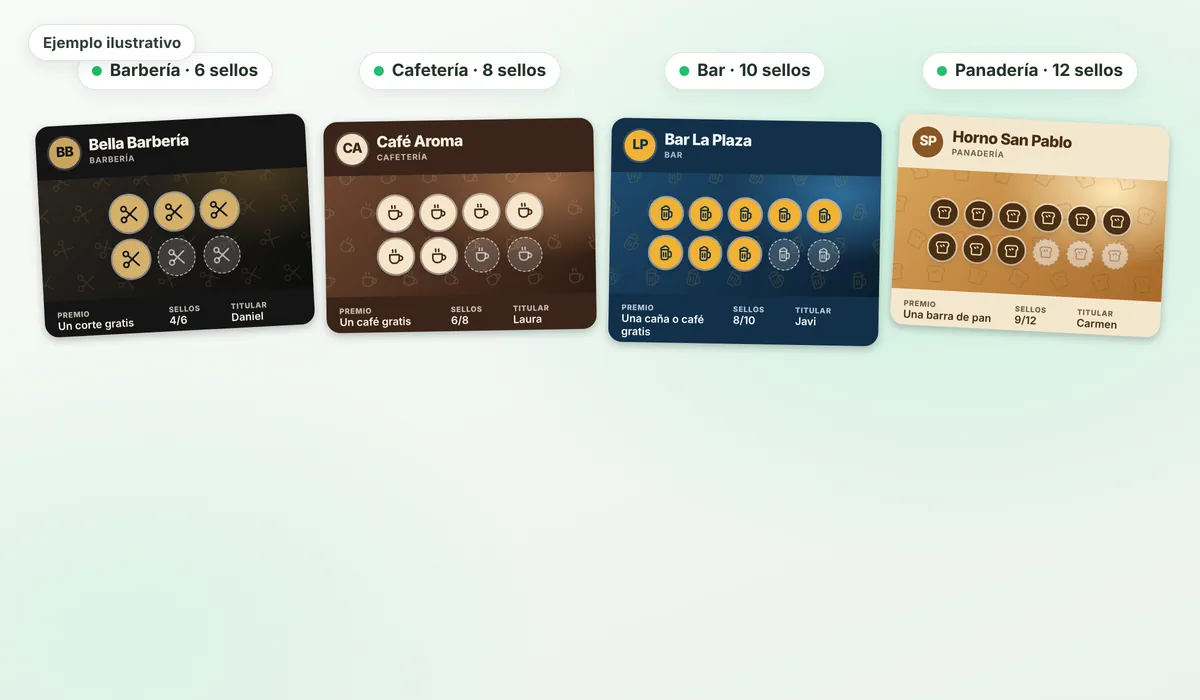
| Business | Usual stamps | Typical reward |
|---|---|---|
| Café | 8 – 10 | Free coffee |
| Bar | 8 – 10 | Beer or tapa |
| Restaurant | 5 – 8 | Dessert or drink |
| Bakery | 10 – 12 | Baguette or bun |
| Ice cream shop | 6 – 10 | Ice cream |
| Barbershop | 5 – 6 | Haircut or beard |
| Hair salon | 5 – 8 | Treatment |
| Beauty and nails | 6 – 10 | Nail design or polish |
| Gym or studio | 8 – 12 | Free class |
These are rough ranges, not rules. Adapt them to how often your customer comes in.
What if I sell session packs?
If instead of rewarding you sell packs in advance (five haircuts, ten classes), you don't need a number of stamps: you need a prepaid pack. See the digital prepaid pass card. For promotions by industry, read promotions for barbershops and beauty salons.
Tricks to get the card completed
- Give the first stamp on sign-up: a card that starts at 1 of 8 gets completed more than one that starts empty.
- Double stamps during your slow hours or days: you move customers and the card fills up faster.
- Remind them of the reward: a notification when they're close, or when it's ready, brings the customer back.
With Rondafy you can change the number of stamps and the reward from the dashboard at any time, and on the Standard and Pro plans the card notifies the customer when their reward is ready.
To reward spend rather than visits, see points card or stamp card.
Frequently asked questions
How many stamps does a loyalty card usually have?
Most commonly between 6 and 10 stamps. Daily-purchase businesses usually use 8 to 12, and less frequent services like barbershops 5 or 6.
Is it better to have a card with few or many stamps?
With few stamps the reward comes sooner and motivates more, but costs more margin. Ideally a regular customer completes it within a few weeks or, for less frequent services, within a few months.
Can I change the number of stamps later?
With a digital card like Rondafy, yes: you change it from the dashboard. It's best to respect cards that were already started.
How many stamps should a coffee card have?
8 to 10 is the norm. If the customer comes every day, consider 10 or 12; if they come a couple of times a week, 8 usually gets filled in a month. The step-by-step calculation is in how many stamps to put on a coffee card.
Can customers start the card with a free stamp?
Yes; it's a very common trick so nobody starts from zero. With a digital card it happens when they save it.