Short answer: VIP tiers in a loyalty programme are levels the customer climbs according to what they spend or how often they come (for example Bronze, Silver and Gold), and each level gives a better perk than the one before. In a local business they work well with three tiers, a first level that's easy to reach, perks that don't eat into your margin and a card on the phone that shows the customer how far they are from the next tier.
What are VIP tiers in a loyalty programme
On a normal stamp or points card, every customer plays by the same rules: so many stamps, such a reward. Tiers add another layer: as well as redeeming rewards, the customer builds up status. When their total spend passes a certain amount, they move up a tier and get a lasting perk (for as long as they stay in that tier), such as a discount, a gift or preferential treatment.
Airlines, hotel chains and big cosmetics brands have done this for years. The idea is the same in a café: your best customer should feel they are, and a customer about to move up should have a reason to come back one more time.
When they make sense in a local business (and when they don't)
Tiers are an extra, not the first step. They're worth it if:
- You already have a loyalty card running and you know how much your customers spend.
- There's a clear difference between customers: some come now and then and others are almost part of the family.
- The ticket varies (restaurants, shops, beauty salons) or the customer comes back a lot throughout the year.
- You can offer something your best customers value and that doesn't cost you much.
Don't complicate things with tiers if you've just started, if hardly anyone comes back or if your team isn't yet used to scanning the card at every sale. To begin with, a digital stamp card or a points card is more than enough.
By spend or by visits: what to measure for moving up
There are two ways to decide who moves up:
- By cumulative spend (euros): rewards whoever buys the most from you. It's the fairest when tickets are very different. It's how Rondafy does it.
- By visits (number of purchases): rewards frequency. It fits when the ticket is almost always the same, as with a coffee or a haircut.
A third variant is to count only the last 12 months, so the tier has to be "kept". It's common with airlines, but in a local business it tends to cause more complaints than benefits: nobody likes moving down. If you're starting out, better that tiers don't expire.
How many tiers to have
Three is the most common number and the easiest to understand: an entry tier, a middle one and one for your best customers. With two it falls short as a game; with more than four, the customer can't remember which one they're in or what each gives them. In Rondafy you can create 2 to 5 tiers.
Names matter less than you'd think, but they help: Bronze, Silver and Gold need no explanation. You can also use names from your business ("Customer", "Regular", "Family" in a bar; "Friend", "Regular", "VIP" in a barbershop). Keep them short: they appear on the card.
How to set the spend for each tier
Don't copy another business's figures: they depend on your average ticket and how often your customer comes back. A simple method:
- Work out what a regular customer spends in a year. Average ticket × visits per year. If you have a points card with amounts, you already have that figure.
- First tier: something a new customer can reach in a few weeks. It shows them the system works.
- Middle tier: what a regular customer spends in a few months.
- Top tier: what your best customers spend in a year. It should be a minority.
A made-up example to show the calculation: a café with an average ticket of €4 and a regular who comes three times a week spends about €600 a year (€4 × 150 visits). It could set Bronze from €0, Silver from €150 (about three months as a regular) and Gold from €500. In a barbershop with €15 cuts every four weeks (about €195 a year), the thresholds would be much lower.
| Business (example) | Entry tier | Middle | Top | Top-tier perk |
|---|---|---|---|---|
| Café | From €0 | 150 € | 500 € | A free coffee on moving up and priority on orders |
| Restaurant | From €0 | 200 € | 600 € | A house dessert or drink on every visit |
| Barbershop | From €0 | 90 € | 180 € | A free beard trim with every cut |
| Beauty salon | From €0 | 250 € | 700 € | A free treatment on moving up and priority appointments |
The figures in the table are examples to show the method, not recommendations: calculate your own with your average ticket and your margins.
Which perks to give at each tier
The temptation is to give a bigger discount at each tier. It works, but it eats your margin precisely with the people who buy the most. Some perks are valued just as much or more and cost less:
- A gift on moving up a tier: given only once and it creates a moment ("You're Gold now!"). It's easy to control.
- Priority: appointments before anyone else, a table on busy days, putting aside the weekend bread or pastries.
- Something exclusive: trying a new product first, a flavour only for Gold customers, an invitation to a tasting.
- Points that go further: if you use points, make each purchase earn a bit more in the top tier.
- A small, fixed discount: if you give one, keep it modest and in the top tier.
Before deciding, work out what each perk costs you (not its menu price). More ideas in reward ideas for your loyalty card.
How to communicate it so it works
- The customer should see their tier without asking. Ideally it appears on their card, with how far they are from the next one.
- Let them know when they move up. A message on their phone the moment they reach a new tier is worth more than any poster.
- Explain it in one sentence. "The more you come, the better: from €150 you're Silver and you get…". If you need a leaflet to explain it, it's too complicated.
- Make sure your team knows it. A "congratulations, you're Gold now" at the till does more than the discount itself.
Common mistakes
- Setting the first tier too high: nobody moves up and the system looks like decoration.
- Too many tiers, or tiers with similar perks.
- Moving customers down without warning, or changing the figures every month.
- Perks you can't always deliver (for example, "guaranteed table" in a small venue).
- Not measuring: if you don't know how many customers are in each tier, you don't know whether it works.
How to measure whether tiers are working
Each month, look at how many customers are in each tier and how many move up. If almost everyone stays in the first, lower the second threshold. If almost everyone reaches the top, raise it for new tiers or add one. And compare the spend of top-tier customers with everyone else's: they should come back more often, not just spend the same with a discount. More metrics in the loyalty programme guide.
How tiers work in Rondafy
In Rondafy, tiers are an option of the points card, included in the Pro plan. This is how they work:
- You create 2 to 5 tiers, each with its name, the cumulative spend required in euros and its perk.
- Each customer's tier comes from everything they've spent with their points card (the amounts your team enters at checkout). Points added by hand, without an amount, don't count as spend.
- When you switch them on, your existing customers start directly in the tier that matches what they've already spent.
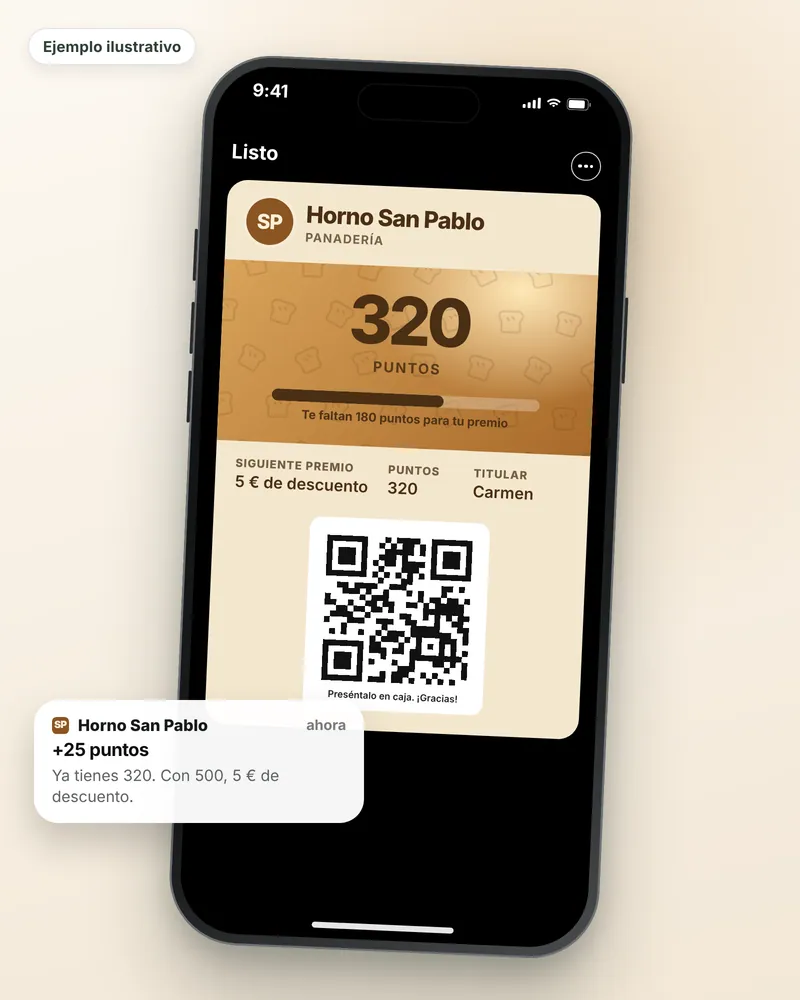
- The customer's card in Apple Wallet or Google Wallet shows their tier, their perk and how far they are from the next one.
- When they move up, they get a notification on their phone ("You're Gold tier now!").
- Optional: each tier can have its own colour, and the card changes colour when they move up.
- Optional: a gift on moving up a tier, which stays pending on the card until you redeem it once from the scanner. You can note what it costs you to see it in your numbers.
- Tiers don't expire: they only go down if a ticket is undone or if you raise the thresholds.
The Pro plan costs €39.99/month or €399.90/year (excl. VAT), with a 14-day free trial and no commitment. Everything each plan includes is in plans and pricing, and the comparison with other tools in the best loyalty apps in Spain (in Spanish).