Short answer: find out how long one of your customers normally takes to come back, set twice that time as your warning sign, send them a single personal message (without pestering) and, if appropriate, offer something small to encourage them back, such as a free stamp. Don't do it more than once, or to anyone who hasn't given you permission to receive marketing.
Every business with regulars has the same experience: one day you realise someone who used to come every week hasn't shown up for a month. Sometimes they've changed jobs, sometimes they've gone to the competition and sometimes they've simply forgotten.
The good news is that winning back a customer who already knows you is usually easier than finding a new one, and mostly takes consistency. Here's a four-step method.
Step 1. Define what "not coming back" means for your business
There's no universal time frame; it depends on how often your customer comes in. As a rule of thumb (our own criterion, not a statistic): if someone usually comes every X days, start to worry when about 2 × X have passed.
As a guide, a salon management blog suggests keeping an eye on customers who haven't been back in 30, 60 or 90 days, and proposes thresholds of 30 to 60 days for beauty and 60 to 90 days for medical or aesthetic treatments (AgendaPro; these are the author's recommendations, not measured data). Roughly:
| Business | Usually comes back every... | Warning from... |
|---|---|---|
| Café or bakery | A few days | 2 or 3 weeks |
| Bar or restaurant | 1 to 3 weeks | 1 to 2 months |
| Barbershop | 3 to 5 weeks | 6 to 10 weeks |
| Beauty salon | Depends on the treatment | Twice the usual interval |
Adjust the table based on what you see in your shop. If you have a dashboard with your customers, look for the ones who've hit that time frame; with Rondafy you can see segments such as inactive customers and those close to their reward.
Step 2. Write a short, personal message
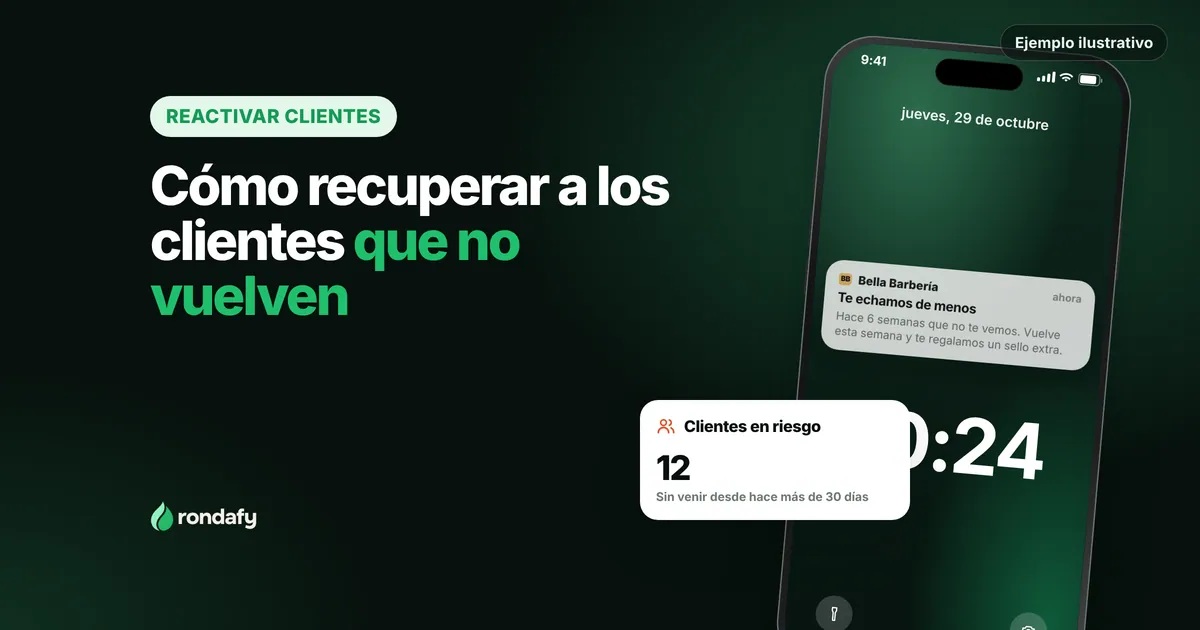
A good win-back message is short, sounds like a person and doesn't sound like a campaign. Three examples to adapt:
- Café: "Hi Laura. We haven't seen you for a few days and just wanted to check all's well. Your card is on 7 of 10 stamps: you're really close to your free coffee."
- Barbershop: "Hi Pablo. It's been a while since your last cut. If this week works for you, we'll save you a slot."
- Beauty salon: "Hi Marta. It's been a few weeks since your last session and we wanted to see how it went. If you'd like to pick it up again, message us and we'll sort it out."
What they have in common: they use the name, don't apologise for getting in touch, give a specific reason and leave the door open. Messages that mention the last service or offer something specific tend to work better than generic ones (AgendaPro).
To be clear: Rondafy lets you send notifications to cards saved on the phone and doesn't handle bookings, so you arrange the slot or appointment yourself as usual.
Step 3. Offer something small and sensible
If the message alone isn't enough, a small incentive helps, without giving away your margin:
- A free stamp on their card: it costs you next to nothing and brings them closer to the reward.
- Something of value, not a discount: a care product, an extra in the service, a drink. A barbershop blog warns that frequent discounts attract people who are only after deals (AgendaPro).
- Something with an end date: "this week" or "until Sunday". Without a date, there's no reason to come today.
Always work out the real cost. More ideas in reward ideas for your card.
Step 4. Ask, listen and don't repeat yourself
- Ask why. If the customer replies, learn from it: a bad experience, a change of schedule, price. It's free information.
- Once, or twice at most. A second message, after a while, can be fine; a third is too much.
- Respect opt-outs. If someone tells you they don't want messages, don't send them any more. And remember that sending marketing generally requires the customer's consent: we explain it in what data to ask your customers for (GDPR, in Spanish), with the caveat that it isn't legal advice.
How to stop them leaving (better than winning them back)
Almost everything is achieved before they leave: a loyalty card that gives the customer a reason to come back, a "just 1 stamp to go" notification when they're close to their reward and a simple way to see who's starting to space out their visits.
To see how to set it up, see the digital stamp card and the customer loyalty programme guide. By type of business, in industries.
Mistakes that stop it working
- Waiting too long. The more time passes, the harder it gets. Check every month who you need to message.
- A generic message. "We miss you" sent to everyone without a name sounds like spam.
- Huge rewards. If the incentive costs more than the visit, it doesn't pay.
- Not measuring. Note how many messages you send and how many people come back; with three months of data you'll know whether it's worth it.
Frequently asked questions
How long before you write a customer off as lost?
It depends on your business. A rule of thumb is to wait twice as long as they usually take to come back; in beauty, an industry blog suggests looking at 30 to 60 days.
What message works best to win customers back?
A short one, with their name, that mentions something specific (their last service or how close they are to their reward) and leaves the door open.
Can I message any customer who stopped coming?
Not always. Sending marketing generally requires the customer's permission; check with your accountant or adviser.
Sources (checked on 29 October 2026)
- AgendaPro, "Clientes que no regresan: cómo detectarlos a tiempo y recuperarlos" (in Spanish): https://agendapro.com/blog/fuga-de-clientes/
- The twice-the-time rule and the table of time frames are our own rough criteria, not statistics. The sample messages use made-up names.