
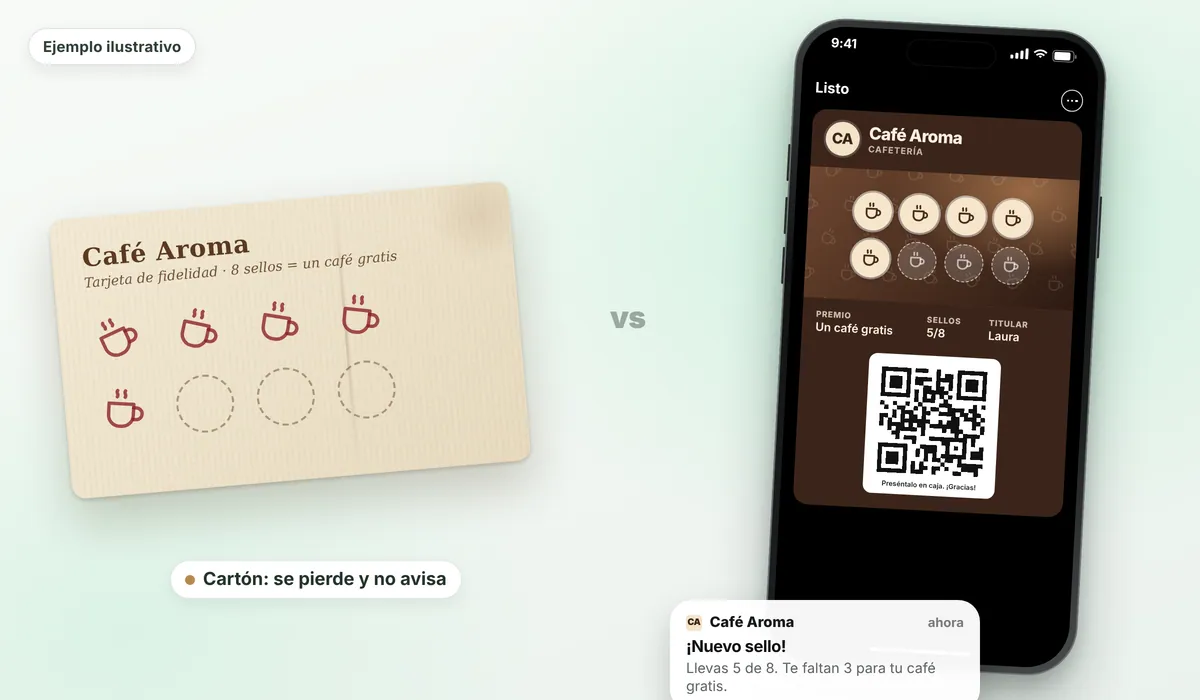
A paper loyalty card is cheap and everyone knows it; a digital one doesn't get lost, can't be faked and tells you who comes back. Which one suits you depends on your customers and how much you want to know about them. This guide compares the two, warts and all, and tells you when paper still makes sense.
Quick comparison
| Paper | Digital (Wallet) | |
|---|---|---|
| Cost to get started | Very low: printing | Monthly subscription (with Rondafy, the Standard plan costs €24.99/month + VAT) |
| Recurring cost | Reprinting every time you change the reward or design | No reprints |
| Gets lost or forgotten | Easily | It's on the phone |
| Fake stamps | Easy to copy | Every stamp is recorded when scanned |
| Information about your customers | None | Visits, repeat rate, at-risk customers |
| Customer notifications | No | Yes (Standard and Pro plans) |
| Works without a phone or internet | Yes | No: needs a phone and internet |
| For customers without a smartphone | Yes | Best to keep paper for a while |
With Rondafy, notifications and detailed stats are on the Standard and Pro plans.
They get lost and forgotten
A paper card gets left at home, gets wet or ends up in the bin with the receipt. Every time that happens, that customer starts from zero or simply stops taking part. The digital one lives on the phone, which the customer always carries.
Fraud and fake stamps
Ink stamps can be copied and cards can be filled in among friends. On a digital card each stamp is recorded when the business scans the card, so there are no extra stamps.
Data to make decisions
With paper you don't know how many customers come back, how often they come or who has stopped coming. With a digital card you see it in your dashboard and can act: send a notification to someone who hasn't been in for a while or reward your best customers.
When paper still makes sense
If your customers are mostly elderly without smartphones, or if you have hardly any repeat customers, paper may be enough. You can also keep both systems for a while during the transition.
If your customers are very elderly and barely use their phones, if they rarely come back, or if you just want to test the idea of a loyalty scheme with a few hundred cards, paper is a perfectly valid way to start. The usual path is to start with paper and move to digital when you want to know who comes back.
How to switch from paper to digital without losing customers
Switching doesn't mean throwing out all the paper cards at once: it takes a few weeks, accepting half-filled paper cards and giving a welcome stamp on the digital card. The full 5 steps are in alternative to the paper stamp card.
Still unsure? What should I do?
Try digital free for 14 days with your most regular customers and keep paper for anyone who prefers it. Within a week or two you'll see how many save it and how many collect stamps. If you still have doubts, design your card and see how it looks.
For more context, see how a digital stamp card works or the guide to setting up a customer loyalty programme.