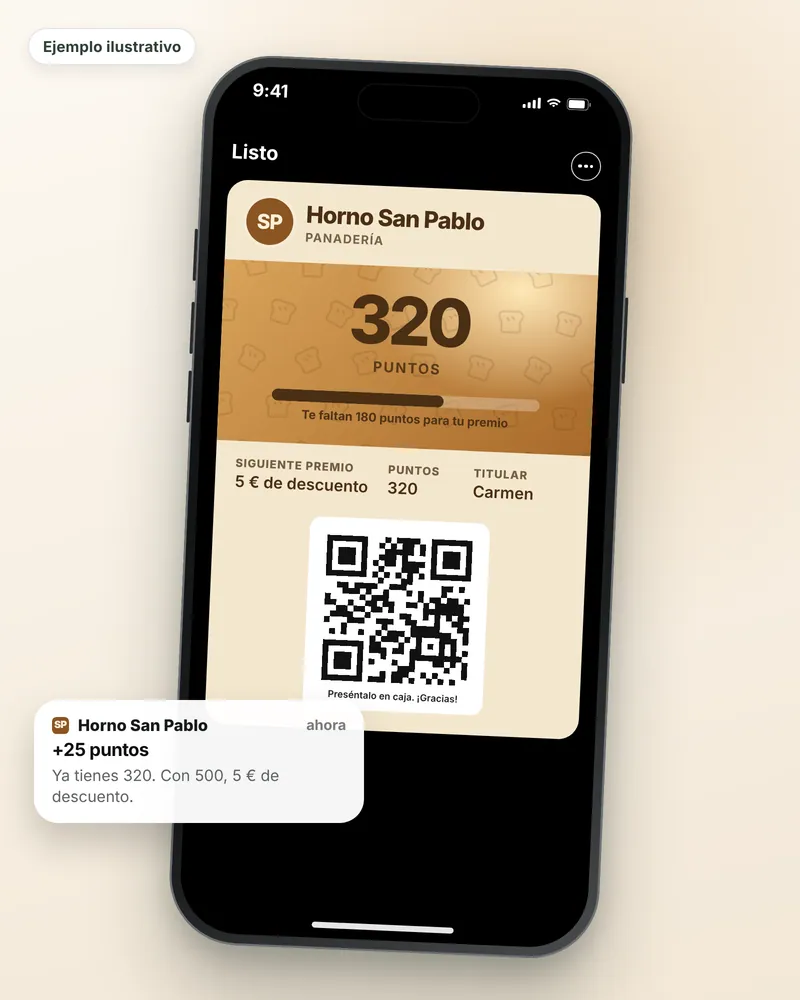
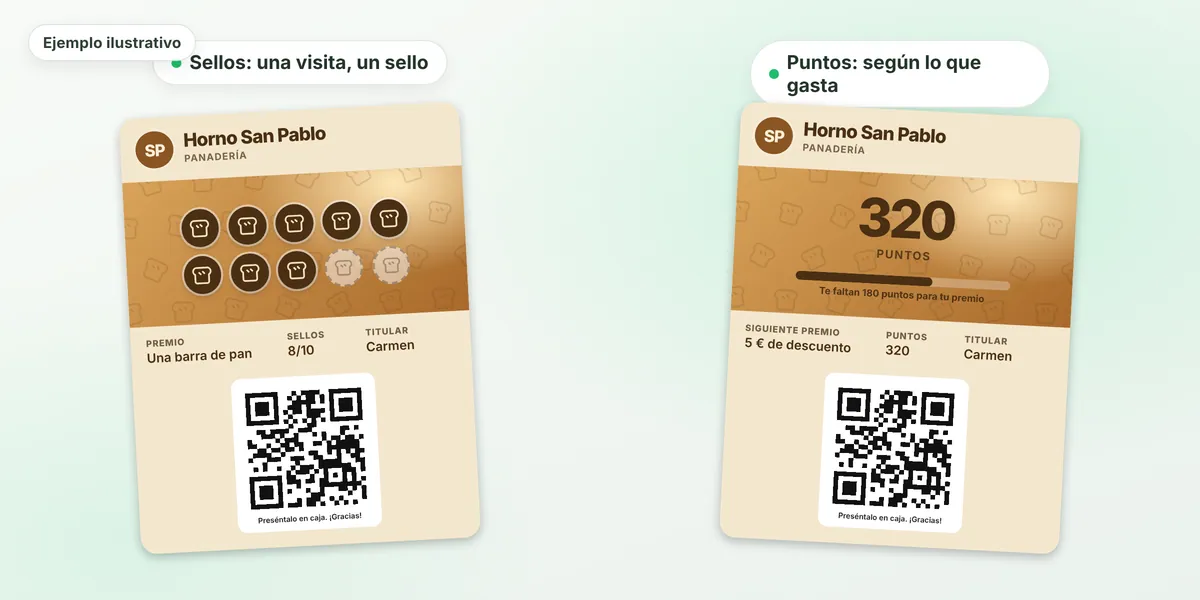
A digital points card rewards what each customer spends: for example, one point per euro, with rewards once they reach a certain amount. The customer saves it in Apple Wallet or Google Wallet, with no app, and their points balance updates on their phone. It's an alternative to the digital stamp card, which rewards visits.
The difference in one sentence
A stamp card rewards visits (one stamp per visit). A points card rewards spend (some points per euro). One counts visits; the other, money.
When to choose a stamp card
- When the ticket is similar on each visit: coffees, haircuts, nail infills, classes.
- When you want something very easy to explain at the counter.
- When your goal is for customers to come more often.
It's the most common option in hospitality and neighbourhood services, and the one Rondafy includes in every plan. If you go for stamps, see how many stamps to put on your card.
When to choose a points card
- When spend varies a lot between customers or visits: shops, restaurants with very different tickets.
- When you want to reward those who spend most, not just those who come most.
- When you offer a catalogue of rewards with different «prices» in points.
The trade-off is that it's harder to explain and customers take longer to see the reward getting close.
Points card examples by type of business
- Restaurant: very different tickets (a couple versus a table of eight). Points based on spend, with a dessert or a drink as the reward. More in loyalty card for restaurants.
- Bakery or patisserie with custom orders: daily bread and big cakes on the same card; points reward those who buy the most. More in loyalty card for bakeries.
- Neighbourhood shop: every customer buys different things and the ticket varies a lot.
- Café or bar: almost always stamps; points are harder to explain with small, similar tickets.
How a digital points card works
Just like the stamp card: the customer saves it in Apple Wallet or Google Wallet and, when paying, the business scans it and adds the points for that purchase. The balance updates on their phone instantly and, when it reaches the amount you set, it's exchanged for the reward.
- You decide how many points each purchase earns (for example, one point per euro) and which rewards there are, and from how many points.
- The customer saves the card by scanning your QR code, with no app.
- At the till, your team scans the card and enters the amount; the points are added instantly.
- When the customer has enough points, they redeem the reward and the points are deducted.
With Rondafy the points card is included in both plans, Standard and Pro, just like the stamp card. You switch it on from the dashboard, in Settings → Extra features, and you can run it alongside the stamp card.
How to set up a points programme for your customers
A points programme comes down to four decisions. Make them with your own numbers (average ticket and margin), not another business's:
- How much spend earns a point. In Rondafy you choose "every X € = 1 point": for example, one point per euro. At checkout, your team scans the card, types the ticket amount and the points are added automatically.
- Welcome points (optional). A few points when the card is saved, so the customer starts with something.
- The rewards catalogue. Several rewards with different "prices" in points: a small one that's reached quickly and bigger ones. You can give each reward an end date or leave it with no expiry.
- What each reward costs you. Calculate with what it costs you, not the menu price. If 100 points equal €100 of spend and the reward costs you €3, you're giving 3% back to your loyal customers.
Once it's working, you can add VIP tiers to your points programme (Bronze, Silver, Gold…) to reward your biggest spenders more: in Rondafy it's an option of the points card on the Pro plan, with 2 to 5 tiers based on cumulative spend. If you're choosing a tool, see what a customer loyalty app should include.
Our recommendation
If in doubt, start with stamps. It's simpler for your team and the customer, and it's almost always enough to bring them back more often. If over time you find you need to reward spend, you can expand.
Many businesses start with stamps and add points once they know their customers. You can also run both at once, on both plans.
Points or stamps: quick table
| Stamps | Points | |
|---|---|---|
| What it rewards | The visit | The spend |
| How you explain it | "Your 8th coffee is free" | "One point per euro; 100 points gets you a discount" |
| Best if... | Tickets are similar | Tickets vary a lot |
| Downside | Rewards big and small spenders the same | Harder to explain |
| Example | Café, barbershop, bakery | Restaurant, shop |
The figures in the "How you explain it" row are examples.
Selling session packs rather than rewarding purchases? That's what the digital prepaid pass card is for. And if you're building your programme from scratch, there's the customer loyalty programme guide.