
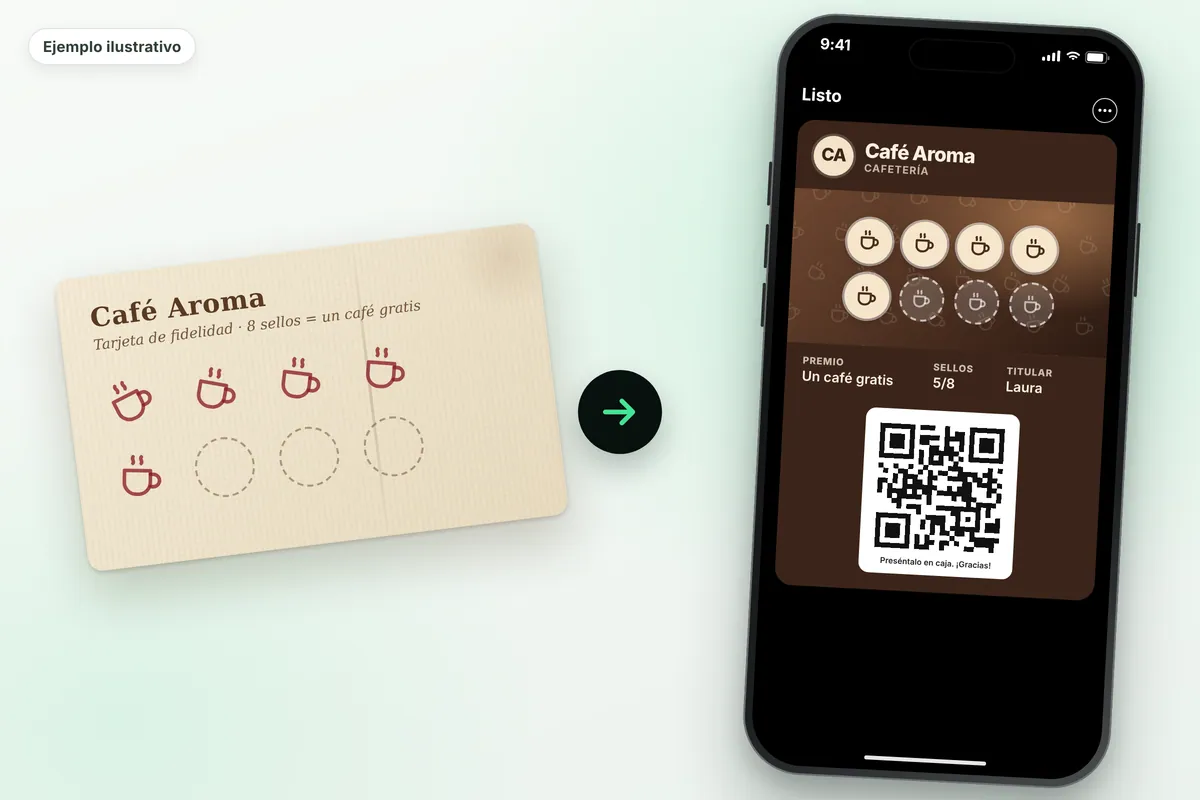
Short answer: The most complete alternative to the paper stamp card is a digital stamp card on the customer's phone (Apple Wallet or Google Wallet): it works the same way, but it doesn't get lost, can't be over-stamped and tells you who comes back. If you'd rather not change format, you can stick with paper or use a notebook, but you'll lose the information.
Why people look for an alternative to paper
Paper works until it doesn't. What usually makes a business look for something else:
- It gets lost or forgotten. The customer keeps it in their wallet with twenty others, and when they reach the counter they haven't got it.
- It can be over-stamped. Anyone can copy an ink stamp with a pen, and staff sometimes give extra ones by accident.
- It tells you nothing. You don't know how many customers use it, how often they come or who has stopped coming.
- You have to reprint every time you change the reward or the design.
The alternatives, pros and cons
| Alternative | What it is | Pros | Cons |
|---|---|---|---|
| Stick with paper | A printed card with ink stamps | Cheap to start; everyone knows it | Gets lost, can be faked, no data |
| Notebook or spreadsheet | You write down each customer and their visits | Full control; no cost | Relies on asking for a name or phone number and on the team always writing it down; slow at peak times |
| Your own business app | An app for your customers' phones | Your brand on their screen | The customer has to download it; it's costly to build and maintain; hardly anyone wants an app per shop |
| A QR card that opens on a website | A QR code the customer scans to see the card in the browser | No app | Depending on the tool, it may require the customer to register and doesn't sit in the phone's wallet; check before choosing |
| A digital card in Apple Wallet or Google Wallet | The card is saved on the phone, next to tickets and bank cards | Nothing to install; your brand; notifications; dashboard with data | Needs a phone with a connection; the odd customer without a smartphone will stay on paper |
Rondafy is the last type. There are other tools of the same type, and we compare them in best loyalty apps for businesses in Spain (in Spanish).
What you gain by moving to a digital card
- The same rule you already have. If today you give a free coffee every 8, you can keep doing exactly that: digital stamp card.
- A design with your logo and colours and whatever reward you like, without reprinting when you change it: the change also reaches the cards your customers have already saved.
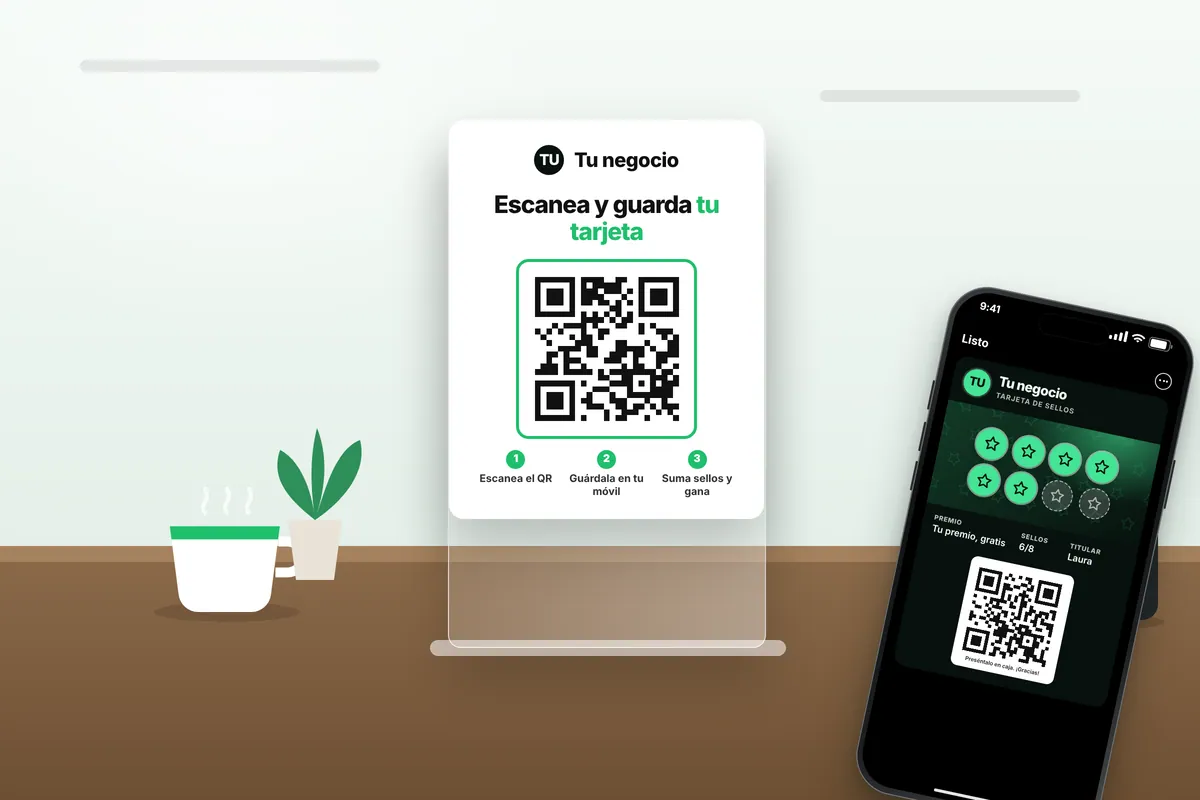
- Sign-up in seconds: the customer scans a QR code on your counter and saves the card, with no app or forms.
- Stamps that can't be faked: every stamp is recorded when your team scans the card.
- A dashboard: active customers, repeat rate, who's close to their reward and who has stopped coming.
- Phone notifications: "just 1 stamp to go", birthdays, customer win-backs and manual or group messages (Standard and Pro plans).
- Review requests, several locations (each extra location, €10/month) and activity export to CSV, which opens in Excel.
How to move from paper to digital in 5 steps (without losing your customers)
- Design the digital card with your logo, the reward and the number of stamps. With Rondafy you can preview it in design your card and it can be ready the same day.
- Put the QR code on the counter and promote it: a poster by the till and one line from your team ("Would you like the card on your phone?") is enough.
- Give a welcome stamp to anyone who saves the digital card. It's the simplest incentive to get them to switch.
- Accept half-filled paper cards for a few weeks. If someone brings a paper card with stamps, add those stamps to their digital card. That way nobody feels they're losing what they had.
- Stop printing once most of your regulars have the digital card. Anyone without a smartphone can stay on paper; there's no need to shut anyone out.
What a digital card doesn't solve
To be clear: you need a phone, tablet or computer with internet to stamp (it doesn't work offline), and some customers will still prefer paper. If your customers are very elderly or rarely come back, paper may still make sense for a while; we cover it in the paper vs digital comparison.
What it costs
Paper seems free, but printing is a recurring cost and tells you nothing. Rondafy costs: Standard €24.99/month or €249.90/year; Pro €39.99/month or €399.90/year (excluding VAT; 21% is added in Spain). 14-day free trial and no commitment. All the details are in plans and pricing.