Short answer: a loyalty platform is software that replaces the paper card: it records each customer's visits or spend, rewards them for coming back and shows you who returns. In local retail there are two ways to use it: each shop has its own card (the most common option and what Rondafy does) or a whole street, market or town shares a common card, something usually driven by traders' associations and town councils, which needs a different kind of platform.
What is a customer loyalty platform
It's the set of tools a business uses to run its loyalty programme: the card the customer carries, the system to add stamps or points at the till, the rewards, the notifications and the statistics. It's also called loyalty software, app or system; we explain it in more detail in customer loyalty app for small businesses and compare real tools in the best loyalty apps in Spain (in Spanish).
For a neighbourhood shop, a good platform has to be quick at the till, ask the customer to install nothing and cost little each month. What sets it apart from platforms for large chains is that you don't need complex integrations or a marketing team to use it.
Two models for local retail
| One card per shop | A shared card (town, market or street) | |
|---|---|---|
| How it works | Each shop gives its own card and reward; the customer has one card per shop on their phone | The customer has a single card and collects at every participating shop |
| Who decides | Each shop: reward, stamps, design and notifications | A shared manager (association or town council) with rules for everyone |
| Launch | Days: each shop signs up and puts up its QR code | Months: agreement between shops, sharing rules, joint communication |
| Who pays for the rewards | Each shop pays for its own | It has to be agreed (each shop, a common fund or a subsidy) |
| Data | Each shop sees its own | The manager sees the whole picture; you need to define who is responsible for the data |
| Best for | Any shop that wants to start now | Local promotion campaigns with a budget and a dedicated manager |
They're not incompatible: an association can encourage its members to each have their own digital card and, separately, organise joint campaigns (a tapas trail, a local shopping week, prize draws) that each shop announces to its own customers.
If you're a shop
Start with your own card. You don't depend on anyone, it's ready the same day and you decide the rewards. The usual choice is a digital stamp card (one stamp per purchase), a points card if tickets vary a lot, or a session pass card if you sell sessions. There are examples by activity in loyalty cards by sector.
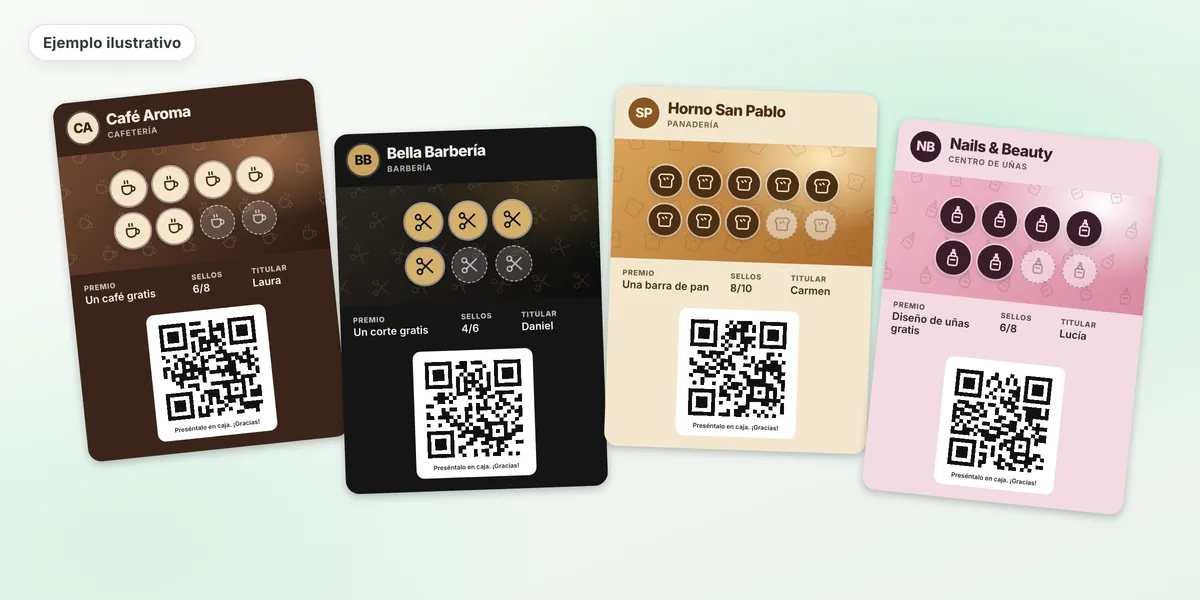
With Rondafy your customers save the card in Apple Wallet or Google Wallet by scanning a QR code, without downloading any app, and you add stamps from your phone. You can notify them when they're 1 stamp away, on their birthday or when they haven't been in for a while. If you have several shops, each extra venue is €10 a month and your customers use the same card in all of them; with the Pro plan you can have up to 3 different businesses in the same account, each with its own card.
If you're a traders' association
What helps your members most usually isn't a new platform that someone has to maintain, but for each of them to drop the paper card and have their own well-explained digital card. Some ideas that don't need a shared card:
- A hands-on session for members on how to set up their loyalty card (how many stamps, what reward, how to get customers to save it). We can run it in person if you're in Valencia or La Ribera, or by video call.
- A joint campaign with a date and a shared poster ("this month, double stamps in the neighbourhood's shops") that each shop applies on its own card.
- An agreement for members: the association can apply to join the Rondafy partner programme to introduce Rondafy to its members or resell it at its own price.
If what you want is a shared card where the customer collects at every shop, that needs a collective loyalty platform, with a manager and common rules. Rondafy doesn't offer that today.
If you're a town council
Town councils usually look for two things: vouchers or discounts to stimulate spending in local shops (often with public money) and tools to help shops go digital. The first needs specific municipal voucher platforms, with control and accounting of public spending; that's not what Rondafy does. For the second, a digital loyalty card per shop is a simple way for each store to have its own programme without apps or special equipment.
If a town council or local development agency wants to organise training or an event for shopkeepers on customer loyalty, write to us and we'll see how it fits.
What to ask of any loyalty platform
- That the customer can sign up in seconds, without downloading an app or filling in a long form.
- That adding a stamp or some points at the till takes a few seconds.
- That it doesn't ask for more personal data than necessary and that it's clear who is responsible for it (see the loyalty programme guide, privacy section).
- Phone notifications and statistics that are easy to understand.
- A clear price per shop and per month, with no commitment and a free trial.
- That you can take your data with you if you leave.
What it costs
For a shop, the tools we've compared range from free plans with limits to about €50 a month per venue (details in how much a digital loyalty card costs). Rondafy: Standard €24.99/month or €249.90/year; Pro €39.99/month or €399.90/year. Prices excl. VAT (21% is added in Spain), 14-day free trial and no commitment. If you've just opened your business, you can ask for a temporary special price in plans.
Collective town-wide or municipal voucher platforms are quoted separately, depending on the number of shops and the management service: always ask for the total cost per shop and per year.
What Rondafy does and doesn't do
It does: stamp, points, gift, pass and prepaid cards in Apple Wallet and Google Wallet for each shop; sign-up by QR code; notifications; statistics; several venues and several staff members; VIP tiers on the Pro plan.
It doesn't: a shared card across different shops, municipal vouchers with public money, bookings or offline use. If that's what you need, better to know up front.