Short answer: A customer loyalty programme is the system a business uses to reward people who buy from it more than once, so they keep choosing it. It can be as simple as a card that collects a stamp per visit, or as elaborate as a club with tiers and personalised notifications. For a local business, it almost always starts simple.
What a loyalty programme is (and what it isn't)
A loyalty programme is a clear rule the customer understands in one sentence ("your 8th coffee is free") and that your business can always deliver. It has three parts: what gets rewarded (visits, spend, sessions), what the reward is and where the count is kept (a paper card, a notebook, a spreadsheet or a card on the phone).
It isn't the same as a one-off promotion. A welcome discount attracts a new customer once; a loyalty programme works to make that customer come back many times. Nor is it an obligation to buy more: if the reward is too hard to get, the customer ignores it.
What it does for a local business
Without made-up data, these are the three things a well-designed programme gives you:
- A reason to choose you when the customer is torn between two similar places.
- Information you don't have today: how many customers come back, how often, and who hasn't been in for a while.
- A direct way to talk to your customers (a phone notification, a message) without relying on social media or platforms.
It doesn't work miracles: it won't fix poor service or a bad product. It works when people already like the business and just need a reason to come back.
Types of loyalty programme
| Type | How it works | When it fits | Downside |
|---|---|---|---|
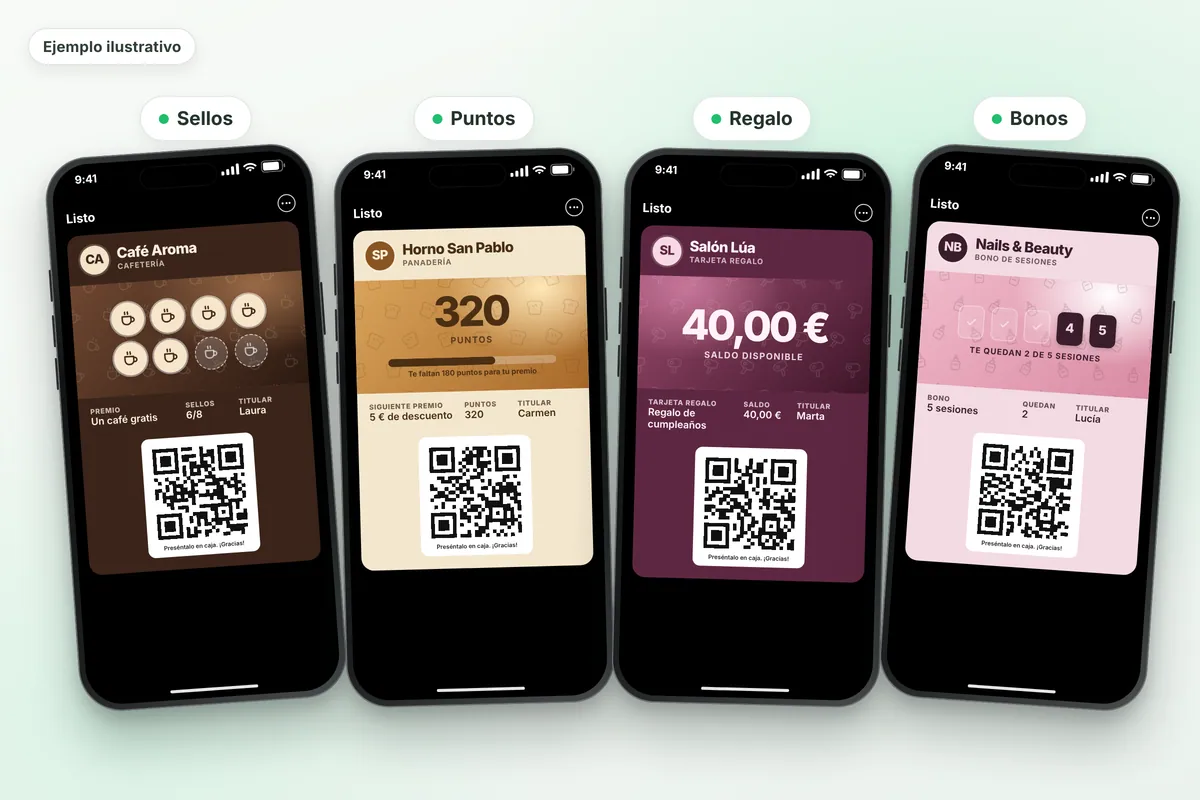
| Stamp card | One stamp per visit or purchase; a full card earns a reward | Similar, frequent purchases: cafés, bars, barbershops, bakeries | Rewards the visit, not the spend |
| Points card | Points based on spend; redeemed for rewards | Highly variable tickets: restaurants, shops | Harder to explain |
| Prepaid passes or session packs | The customer pays for a pack and sessions are deducted | Session-based services: beauty, physiotherapy, gyms | Brings revenue forward more than it builds loyalty |
| Gift card | Credit that's bought and given as a gift | Any business, especially at Christmas and on special occasions | Doesn't reward repeat visits on its own |
| Club or VIP tiers | Tiers (basic, silver, gold) with increasing perks | Businesses with very frequent customers and a budget to run it | More complex to maintain |
| Referral | A reward for bringing someone along | Businesses that live on word of mouth | Needs happy customers first |
If in doubt, start with stamps. They're the easiest to explain and deliver; later you can add points, prepaid packs or a gift card. There's a detailed comparison in points card or stamp card, and a dedicated page on the digital stamp card.
How to choose for your business
| Your business | What usually fits | Where to read more |
|---|---|---|
| Café, bar, bakery | Stamps (lots of visits, small ticket) | Cafés, bars, bakeries |
| Restaurant | Stamps per visit or points for spend | Restaurants |
| Barbershop, hair salon | A few stamps (visits every few weeks); haircut packs | Barbershops, hair salons |
| Beauty salon, nails | Stamps + session packs | Beauty salons, prepaid passes |
| Gym, studio | Stamps for attendance + class packs | Gyms |
| Ice cream shop, seasonal business | Stamps with a reward within the season | Ice cream shops |
If your business isn't on the list, the rule is the same: look at how often your customer comes back and how much the ticket varies. If they come back a lot and the ticket is similar, stamps; if the ticket varies a lot, points; if you sell sessions, prepaid packs. All the pages by type of business are in industries.
Which format to use: paper card, spreadsheet, your own app or a card on the phone
- Paper card: cheap to start and familiar to everyone. It gets lost, left at home, over-stamped, and tells you nothing about your customers. The paper vs digital comparison goes into detail.
- Notebook or spreadsheet: full control, but it relies on the customer giving you their name or phone number and your team always writing it down.
- Your own business app: the customer has to download it, and hardly anyone wants an app for every café. Building and maintaining it is costly too.
- A card in Apple Wallet or Google Wallet: the customer saves it by scanning a QR code, with nothing to install, and you stamp from your phone. This is Rondafy's format. Explained in loyalty card in Apple and Google Wallet.
If you use paper cards today and want to switch, see how to move from a paper card to a digital one.
Which reward and how many stamps
Two rules that work:
- The reward should be reachable in weeks, not months, except for infrequent services (a barbershop, a beauty salon), where it can take a little longer.
- The reward should be something of yours (a coffee, a haircut, a session) rather than a discount that's hard to notice.
Always do the maths with what the reward costs you, not the price you sell it at. The formulas, with examples, are in how many stamps a loyalty card should have, and there are plenty of ideas by type of business in reward ideas.
What to measure to know if it's working
You don't need twenty KPIs. These five cover almost everything:
- Sign-ups: how many customers save the card each week.
- Repeat rate: how many of them come back.
- Redemptions: how many fill the card and claim the reward.
- Frequency: how often a regular customer comes in.
- At-risk customers: who has been away longer than usual.
With a paper card you can't measure any of them. With a digital one, they're in a dashboard. Look at the numbers once a month and change one thing at a time (the reward, the number of stamps, the notification), so you know what worked.
Common mistakes
- A reward that's too far off. If the customer can't see it as achievable, they don't start.
- Rules that change without warning. If you have to change the reward, honour cards that have already been started.
- A team that doesn't offer the card. The best programme in the world won't work if nobody at the till mentions it. Make it an automatic line: "Have you got our card yet?".
- Asking for too much data. Only ask for what you'll use and explain why.
- Sending too many notifications. A useful message is welcome; ten a month is tiring.
Customer data and privacy
A loyalty programme handles personal data if you ask for a name, phone number, email or birthday. Ask only for what's necessary, explain what you use it for and, if you want to send marketing messages, make sure you have the appropriate consent.
With Rondafy, customers can save the card without giving their name, email or phone number, and any data you choose to collect is handled by you as the business; you can see how we explain it in the privacy policy. This is general information, not legal advice: if in doubt, check with your accountant or adviser.
How to set up your programme in five steps
- Decide what you want to achieve (more visits, fewer customers lost, filling quiet hours).
- Choose the type of programme (stamps if in doubt).
- Set the reward and the number of stamps using your own numbers.
- Choose the format and prepare the QR code or the paper cards.
- Launch it: offer it at the till, give a welcome stamp and review the numbers after a month.
The full step-by-step is in how to create a loyalty programme for your business.
Loyalty software for local businesses: what it should include
Loyalty software, platform or app: whatever the name, people are looking for the same thing, a tool that keeps count of stamps or points for you and tells you who comes back. For a local business, this is what to look at:
- The customer should not have to install anything. The less you ask the first time, the more customers sign up.
- Your team should stamp in seconds with the phone or tablet you already have, with no new devices.
- Card types that fit your business: stamps, points, session passes or gift cards.
- Messages to your customers (reward ready, birthday, people who have not come in a while) without depending on social media.
- A dashboard with the five numbers above: sign-ups, repeat rate, redemptions, frequency and at-risk customers.
- Clear pricing, a free trial and no commitment, and the option to export your data if you ever leave.
- What it does not do. Ask whether it connects to your POS, whether it handles bookings and whether it works offline: not every tool does, and it is better to know beforehand.
We compared eight tools used in Spain against these criteria, with their prices, in best loyalty apps 2026.
A loyalty app without the customer downloading anything
You do not need an app to build loyalty from the phone. Apple Wallet (on iPhone) and Google Wallet (on Android) come pre-installed and store loyalty cards just like bank cards or boarding passes. The customer scans a QR code on your counter, adds the card and it stays saved with your logo and colours.
From then on the card updates itself: each stamp appears instantly, messages arrive on the lock screen and, if you change the design, it also changes on cards already saved.
How it differs from your own app
| Your own business app | Card in Apple or Google Wallet | |
|---|---|---|
| What the customer does | Find it in the app store, download it and sign up | Scan a QR code and add the card |
| Where they keep it | One more app on the phone, easy to delete | In the phone's wallet, next to their cards |
| What it costs you | Development, publishing in the stores and maintenance | A monthly fee (with Rondafy, from €24.99/month + VAT) |
| Messages | App notifications, if the customer accepts them | Card messages on the lock screen; the customer can turn them off |
| What extra it gives | It can include orders, bookings or your own content | Fewer features, in exchange for almost no effort for the customer |
Your own app makes sense if you sell through it with orders or bookings, or if your brand is so well known that people want to install it. For a café, a barbershop or a beauty salon, a card on the phone is usually enough. It's explained in digital stamp card and in loyalty card in Apple and Google Wallet. If you're choosing a tool, see what Rondafy offers as a customer loyalty app for shops.
Where Rondafy fits in
Rondafy is a loyalty platform for local businesses, with digital cards: stamps, points, gift cards and session packs (on both plans), in Apple Wallet and Google Wallet, with no apps for the customer. It includes phone messages, review requests, a dashboard with statistics, several locations (each extra location, €10/month) and activity export to CSV.
It doesn't connect to your POS or handle bookings, and it needs an internet connection. There are other tools that do the same; if you want to compare them, read best loyalty apps for businesses in Spain (in Spanish).
Price: Standard €24.99/month or €249.90/year; Pro €39.99/month or €399.90/year. Prices exclude VAT (21% is added in Spain). 14-day free trial and no commitment. More in plans and pricing and in what is Rondafy; if you want to see how your card would look, design it for free.